'
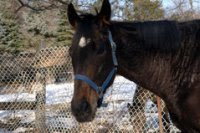
'Secretariat''Secretariat' was the ninth Triple Crown Winner and to date no horse has bested his times. 'Secretariat' had a wonderful retirement, however, other excellent horses have not fared so well. 'Ferdinand' won not only the Kentucky Derby, but also the Breeders Cup Classic.

'Ferdinand'
'Exceller' was the only horse in American racing history to defeat two Triple Crown winners. In the 1978 Jockey Club Gold Cup, 'Exceller' bested both 'Seattle Slew' and 'Affirmed.' Neither 'Ferdinand' nor 'Exceller' had any retirement at all. They were brutally slaughtered at the direction of their owners in Japan and Sweden when they failed to pass their talents to their offspring.

'Exceller'
On July 20, 2007, the California Horse Racing Board announced that they will request a paltry 0.3% of a purse be donated to finance retirement homes for horses that race in California. To the state of California's credit, horse slaughter was banned there in 1998. Despite that, progress remains slow for improved welfare of retired Thoroughbred racehorses. Of course, this very promising idea originated with author Bill Heller as he established the 'Ferdinand Fee.' There is an 'out' clause regarding these small fees; they are voluntary! This is like loose change!! The fees should be absolutely mandatory.
Every horse owner must have a retirement plan in place whether or not the horse is a tremendous athlete such as 'Ferdinand' and 'Exceller' were, or a service horse such as a Mounted Police horse (many MPUs including Lexington, Kentucky do not have a retirement plan for their equine officers), or a beloved companion. Michael Blowen of Old Friends recovers as many studs standing overseas as he can, however, he cannot take them all, even if it were possible to buy all the studs and bring them home. The famous horses are not the only horses deserving of a safe retirement. The Thoroughbred industry is making a positive move, albeit a very weak one. They must do better. We all must do better.
Please note: There are links to pedigrees and racing videos in the content of this blog.
Ellen-Cathryn Nash
President
Manes and Tails Organization
 The Captive Bolt Pistol
This does not kill the horses or any other equid.Among the many responses to the blog entitled 'Beyond Stupid' was a particularly staggering response from an alleged horse protection activist. This 'activist' claims the State of Illinois continuing to allow horse slaughter for carnivore consumption, as well as privately owned horses not intended for human consumption, is a 'non issue'.
This person justifies their contention of this being a 'non issue' by stating the market for carnivore consumption is small, therefore, not too many horses will be slaughtered. ONE slaughtered horse is one too many. The low prices Cavel International is able to charge the zoos compared to slaughtering for human consumption abroad means they will operate at a steady loss and employ only a skeleton crew of their illegal aliens as they pursue their appeal.
Privately owned horses may be brought to Cavel International and slaughtered for a fee. Cavel International manager Jim Tucker has long held that he is providing a service and is simply recycling a resource. Watch him state so by viewing this video from CBS News. The only way the meat from the sub-set of privately owned slaughtered horses can be sold is to be included amongst the horses slaughtered for carnivore consumption.
Cavel International is permitted to engage in interstate commerce to sell the meat of horses slaughtered specifically for carnivores because the Illinois Horse Meat Act expressly allows this. The statute only bans slaughter for human consumption.
One cannot logically, ethically, morally or seriously identify him or her self as an activist working against slaughter of horses if slaughter for any reason with the exception of human consumption is considered a 'non issue'.
Attempting to justify the legality of this type of slaughter as a 'non issue' is paramount to declaring there are exceptions to the banning of horse slaughter that are acceptable. There is absolutely no justification for slaughtering a horse, pony, donkey, mule, or their foals. Horse slaughter is never acceptable.
This 'activist' should view this graphic video of the captive bolt in action documented by the Humane Farming Association. Count how many times this horse was assaulted by the captive bolt. The horse regained consciousness approximately THIRTY SECONDS after being stunned. The horse was fully aware that it was being vivisected.
Does this alleged activist truly think that the use of the captive bolt on the horses slaughtered at Cavel International is any different than that which is documented here? Is it done more efficiently? Does it require less than one blow unlike the horse shown in the video had suffered?
It is a well documented fact that the captive bolt always requires more than one attempt. Do the horses experience less terror? The answer is no. It is not possible. This 'activist' is truly beyond stupid. The 'non issue' argument fails prima facie. Miserably.
Ellen-Cathryn Nash
President
Manes and Tails Organization
 Illinois
'Stupid'
Adjective
1. Lacking mental and physical alertness and activity: hebetudinous, lethargic,sluggish, stuporous, torpid.
The following is the text of the amended Illinois Horse Meat Act which was signed into Law on Thursday, May 24, 2007. Why is this statute stupid? Let me spell it out. This statute prohibits the slaughter of horses and their cousins in the state of Illinois for human consumption. This statute does not prohibit the slaughter of horses and their cousins for consumption by carnivores in zoos.
Essentially, Cavel International will still slaughter horses as they will not be in violation of the new law as long as the horse meat is used to feed lions, and tigers, and bears. It is unclear how much of a demand exists for horse meat at zoos, however, it is believed to be small. Furthermore, there is a very active educational campaign for zookeepers regarding feeding horse meat to their carnivores.

The tragedy is that if the 'and for other purposes' clause had been included, no equids would be allowed to be slaughtered for any reason in Illinois. One equid slaughtered for zoo food is one too many. Someone committed an enormous, unforgivable, egregious error when drafting the legislation. It is almost as if they didn't want horse slaughter to ever end.
Of course, Cavel is suing. The Chicago Tribune reports that:
Owner of DeKalb horse slaughterhouse sues over state ban
Published May 26, 2007
Cavel International Inc., a Belgium-based company that operates a horse slaughterhouse in DeKalb, filed suit Friday in federal court seeking to nullify a state law that closed down the plant.
The law, signed Thursday by Gov. Rod Blagojevich, prohibits the import, export, possession and slaughter of horses intended for human consumption.
Cavel's suit argues the law is an unconstitutional exercise of the state's police power because it does not protect any legitimate health or safety interest.
The suit seeks a temporary restraining order that would allow the plant to continue operating while the suit is being litigated. [End of Chicago Tribune quote].
These grounds are incredibly weak and it is doubtful that Cavel will have any success beyond racking up huge legal fees.
Here is the statute:
Public Act 095-0002
HB1711 Enrolled
LRB095 07034 RAS 27156 b
AN ACT concerning horses.
Be it enacted by the People of the State of Illinois, represented in the General Assembly:
Section 5. The Illinois Horse Meat Act is amended by adding Section 1.5 as follows:
(225 ILCS 635/1.5 new)
Sec. 1.5. Slaughter for human consumption unlawful.
(a) Notwithstanding any other provision of law, it is unlawful for any person to slaughter a horse if that person knows or should know that any of the horse meat will be used for human consumption.
(b) Notwithstanding any other provision of law, it is unlawful for any person to possess, to import into or export from this State, or to sell, buy, give away, hold, or accept any horse meat if that person knows or should know that the horse meat will be used for human consumption.
(c) Any person who knowingly violates any of the provisions of this Section is guilty of a Class C misdemeanor.
(d) This Section shall not apply to:
(1) Any commonly accepted noncommercial, recreational, or sporting activity.
(2) Any existing laws which relate to horse taxes or zoning.
(3) The processing of food producing animals other than those of the equine genus.
(225 ILCS 635/14 rep.) (from Ch. 56 1/2, par. 253)
Section 7. The Illinois Horse Meat Act is amended by repealing Section 14.
Section 10. The Animals Intended for Food Act is amended by changing Section 2.1 as follows:
(410 ILCS 605/2.1) (from Ch. 8, par. 107.1)
Sec. 2.1. When in the interest of the general public and in the opinion of the Department of Agriculture it is deemed advisable, the Department has authority to quarantine or restrict any and all animals intended for human consumption that contain poisonous or deleterious substances which may render meat or meat products or poultry or poultry products from such animals or poultry injurious to health; except in case the quantity of such substances in such animals does not
ordinarily render meat or meat products or poultry or poultry products from such animals injurious to health.
The Department or its duly authorized agent shall investigate or cause to be investigated all cases where it has reason to believe that animals intended for human consumption are contaminated with any poisonous or deleterious substance which may render them unfit for human consumption.
The Department or its duly designated agent in performing the duties vested in it under this Act is empowered to enter any premises, barns, stables, sheds, or other places for the purposes of administering this Act.
The Department may allow the sale or transfer of animals under quarantine or restriction subject to reasonable rules and regulations as may be prescribed.
For the purposes of this Act, the term "Animal" means cattle, calves, sheep, swine, horses, mules or other equidae, goats, poultry and any other animal which can be or may be used in and for meat or poultry or their products for human consumption.
(Source: P.A. 77-2117.)
Section 15. The Illinois Equine Infectious Anemia Control Act is amended by changing Section 4 as follows:
(510 ILCS 65/4) (from Ch. 8, par. 954)
Sec. 4. Tests of equidae entering the State.
All equidae more than 12 months of age entering the State for any reason other than for immediate slaughter shall be accompanied by a Certificate of Veterinary Inspection issued by an accredited veterinarian of the state of origin within 30 days prior to entry and shall be negative to an official test for EIA within one year prior to entry. Equidae entering the State for immediate slaughter shall be accompanied by a consignment direct to slaughter at an approved equine slaughtering establishment.
(Source: P.A. 86-223.)
Section 20. The Humane Care for Animals Act is amended by changing Sections 5 and 7.5 as follows:
(510 ILCS 70/5) (from Ch. 8, par. 705)
Sec. 5. Lame or disabled horses. No person shall sell, offer to sell, lead, ride, transport, or drive on any public way any equidae which, because of debility, disease, lameness or any other cause, could not be worked in this State without violating this Act, unless the equidae is being sold, transported, or housed with the intent that it will be moved in an expeditious and humane manner to an approved slaughtering establishment. Such equidae may be conveyed to a proper place for medical or surgical treatment or, for humane keeping or euthanasia, or for slaughter in an approved slaughtering establishment.
A person convicted of violating this Section or any rule, regulation, or order of the Department pursuant thereto is guilty of a Class A misdemeanor. A second or subsequent violation is a Class 4 felony.
(Source: P.A. 92-650, eff. 7-11-02.)
(510 ILCS 70/7.5)
Sec. 7.5. Downed animals.
(a) For the purpose of this Section a downed animal is one incapable of walking without assistance.
(b) No downed animal shall be sent to a stockyard, auction, or other facility where its impaired mobility may result in suffering. An injured animal other than those of the equine genus may be sent directly to a slaughter facility.
(c) A downed animal sent to a stockyard, auction, or other facility in violation of this Section shall be humanely euthanized, the disposition of such animal shall be the responsibility of the owner, and the owner shall be liable for any expense incurred.
If an animal becomes downed in transit it shall be the responsibility of the carrier.
(d) A downed animal shall not be transported unless individually segregated.
(e) A person convicted of violating this Section or any rule, regulation, or order of the Department pursuant thereto is guilty of a Class B misdemeanor. A second or subsequent violation is a Class 4 felony, with every day that a violation continues constituting a separate offense.
(Source: P.A. 92-650, eff. 7-11-02.)
Section 25. The Humane Slaughter of Livestock Act is amended by changing Section 2 as follows:
(510 ILCS 75/2) (from Ch. 8, par. 229.52)
Sec. 2. As used in this Act:
(1) "Director" means the Director of the Department of Agriculture of the State of Illinois.
(2) "Person" means any individual, partnership, corporation, or association doing business in this State, in whole or in part.
(3) "Slaughterer" means any person regularly engaged in the commercial slaughtering of livestock.
(4) "Livestock" means cattle, calves, sheep, swine, horses, mules, goats, and any other animal which can or may be used in and for the preparation of meat or meat products for consumption by human beings or animals.
"Livestock", however, does not include horses, mules, or other equidae to be used in and for the preparation of meat or meat products for consumption by human beings, which is prohibited under Section 1.5 of the Illinois Horse Meat Act.
(5) "Packer" means any person engaged in the business of slaughtering or manufacturing or otherwise preparing meat or meat products for sale, either by such person or others; or of manufacturing or preparing livestock products for sale by such person or others.
(6) "Humane method" means either (a) a method whereby the animal is rendered insensible to pain by gunshot or by mechanical, electrical, chemical or other means that is rapid and effective, before being shackled, hoisted, thrown, cast or cut; or (b) a method in accordance with ritual requirements of the Jewish faith or any other religious faith whereby the animal suffers loss of consciousness by anemia of the brain caused by the simultaneous and instantaneous severance of the carotid arteries with a sharp instrument.
(Source: Laws 1967, p. 2023.)
Section 97. Severability. The provisions of this Act are severable under Section 1.31 of the Statute on Statutes.
Section 99. Effective date. This Act takes effect upon becoming law.
According to Sec. 2. As used in this Act:
(6) "Humane method" means either (a) a method whereby the animal is rendered insensible to pain by gunshot or by mechanical, electrical, chemical or other means that is rapid and effective, before being shackled, hoisted, thrown, cast or cut; or (b) a method in accordance with ritual requirements of the Jewish faith or any other religious faith whereby the animal suffers loss of consciousness by anemia of the brain caused by the simultaneous and instantaneous severance of the carotid arteries with a sharp instrument.
(Source: Laws 1967, p. 2023.)
This means that equids intended for carnivore consumption will experience the pain and terror of being slaughtered by the use the penetrating captive bolt. Analysis of the Humane Slaughter Act of 1958, amended in 2002, reveals that the use of the penetrating captive bolt is beyond inhumane; it is illegal according to the definitions of the statute.
The Illinois Horse Meat Act does not protect equids bound for carnivore consumption. The state of Illinois invites equids to be slaughtered for carnivore consumption. This statute fails as some equids are still legally eligible to be slaughtered.
 'The Jungle'
What an incredibly well researched statute. The author(s) of the Illinois Horse Meat Act are beyond stupid. They are completely incompetent and had absolutely no business drafting a horse protection bill at all. They should have read 'The Jungle' by Upton Sinclair to learn about the true horror of all slaughter. 'Cliff Notes' are available. I recommend investing in at least a copy of those.
Ellen-Cathryn Nash
President
Manes & Tails Organization